Treat at the right time.
What happens if we escalate now, and what if we wait? A forecast lets the timing of treatment be decided with evidence.
Prognosis, from a digital twin
What comes back is a forecast of their disease, and a way to test treatment decisions before they are made.
1 · The product
The Px Twin workspace follows a patient’s liver through time, and shows where it is heading.
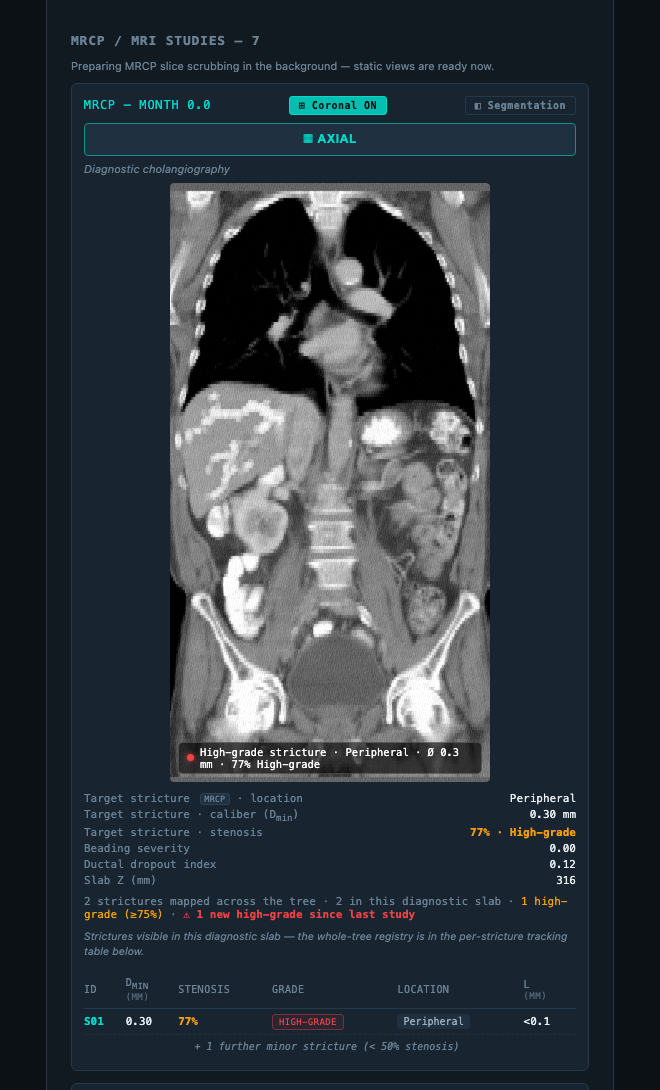
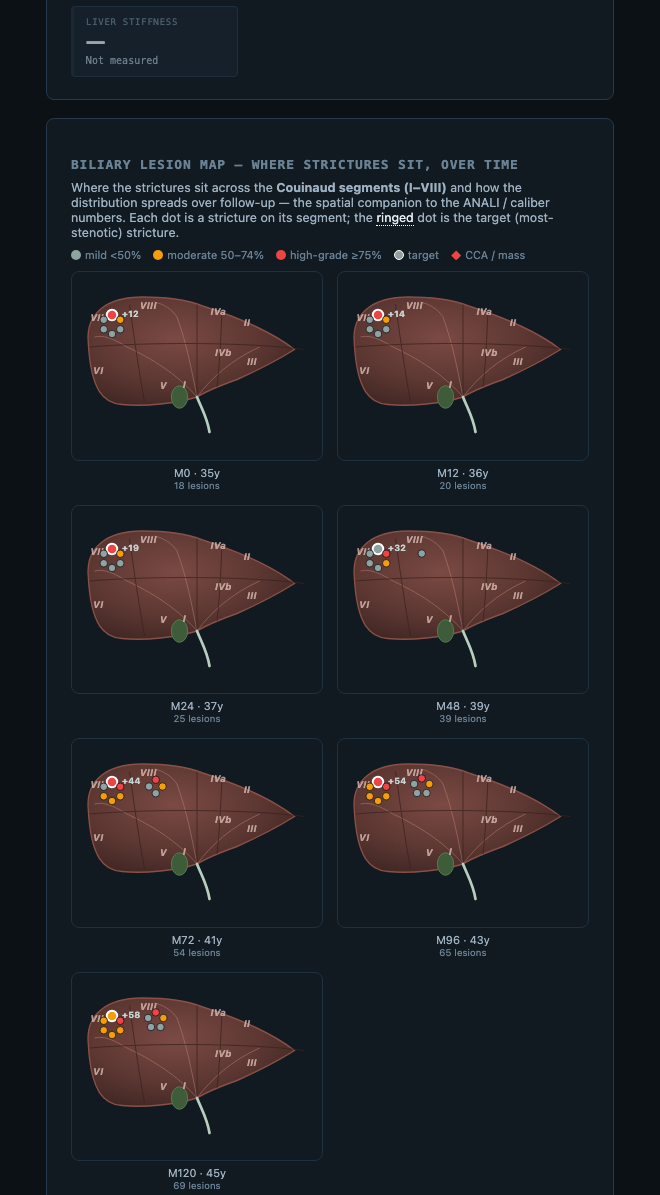
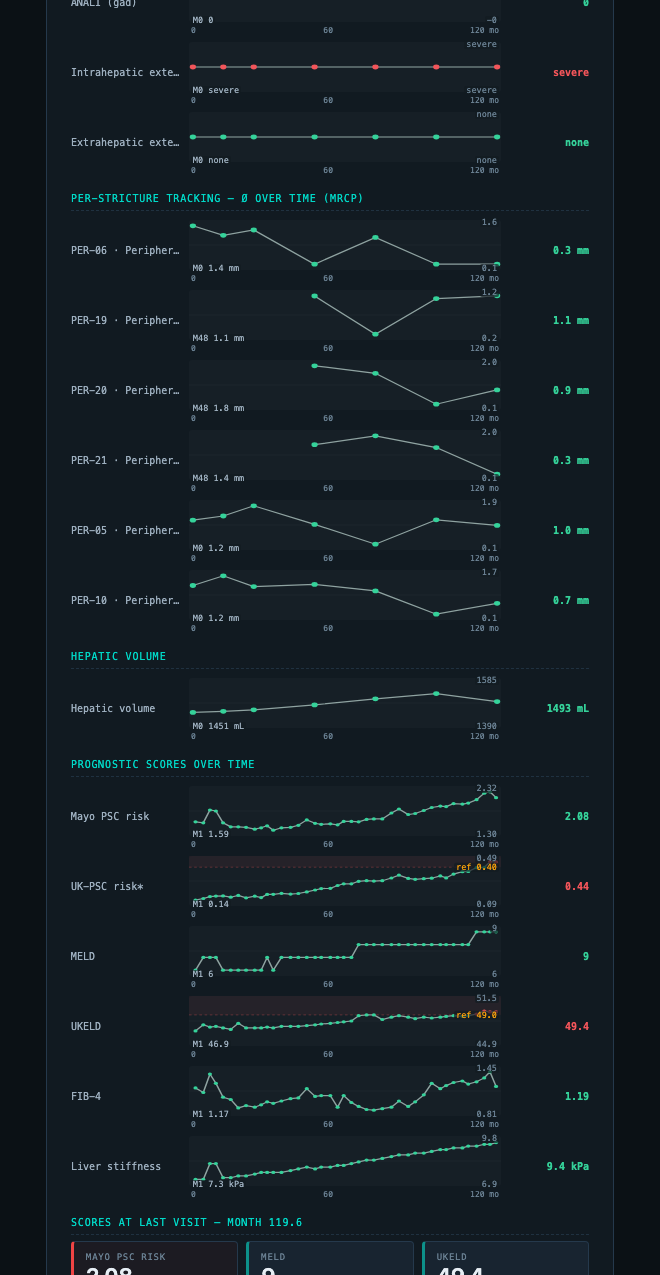
Demonstration data shown, not a real patient.
2 · What a forecast unlocks
What happens if we escalate now, and what if we wait? A forecast lets the timing of treatment be decided with evidence.
Transplant assessment moves earlier when the trajectory demands it. Risks that grow with time are seen while there is still time.
Stable patients are spared scans they do not need. Progressing patients are scanned sooner. Imaging is ordered when it changes a decision.
Pick the patients who will progress inside the trial window. Run the same trial with fewer patients. Test a protocol before recruiting anyone.
Drug developers come first: liver-disease trials are long and expensive precisely because nobody can measure progression well. A clinician-facing service follows regulatory approval.
3 · Where we start
Our first disease is autoimmune sclerosing cholangitis (ASC), the form of primary sclerosing cholangitis (PSC) that begins in childhood. The bile ducts scar and narrow. No therapy is approved to slow it, and no trial in the disease has an approved surrogate endpoint. Prognosis today rests on scores computed at a single moment, and none of them says where the patient is going.
The work is clinically grounded from the first day: it is advised by a consultant transplant hepatologist at a national liver transplant centre.
4 · Team


5 · Contact
Hale House, 76 Portland Place, London W1B 1NT.
Reach us through Jay Liu on LinkedIn.
 London
Px Twin Limited · 17387524
Registered in England & Wales
London
Px Twin Limited · 17387524
Registered in England & Wales